
People Brain
Patria Investimentos (Gente & Gestão)
Client
B2B SaaS, Enterprise AI, Product Strategy, Product Design, Workflow Design
Services
2025
Patria’s G&T team had a challenge of turning their data into decisions. People Brain transformed a manual people analytics workflow into a working AI-powered pilot with two portfolio companies — helping users identify relevant signals, compare companies and peer groups, generate narratives, and connect insights to action plans. OUTCOME People Brain moved from concept to a working pilot with two portfolio companies. We translated Patria’s manual people analytics workflow into a coded MVP that connected the key moments of the analysis process: identifying relevant signals, comparing companies and peer groups, investigating likely causes, generating executive narratives, and turning insights into action plans. Working with business and data teams, the pilot surfaced concrete insights around turnover and extra hours, helping validate that the product could move beyond reporting and support real diagnostic conversations. The work gave Patria a usable foundation for evolving people analytics from static presentations into an AI-powered decision workspace where teams could analyze, explain, decide, and reuse knowledge over time.
MY ROLE: Principal Product Designer I led product strategy and experience design from discovery through working pilot. My work included defining the product narrative, MVP scope, information architecture, core workflows, AI interaction model, and UI direction across Analytics, AI Chat, Reports, Knowledge Hub, Action Plans, Agents, and Automations. I partnered with strategy, technology, business, data, and client stakeholders to translate the opportunity into a coded MVP, validate the experience with two portfolio companies, and clarify what would need to be improved before scaling the product across the portfolio.
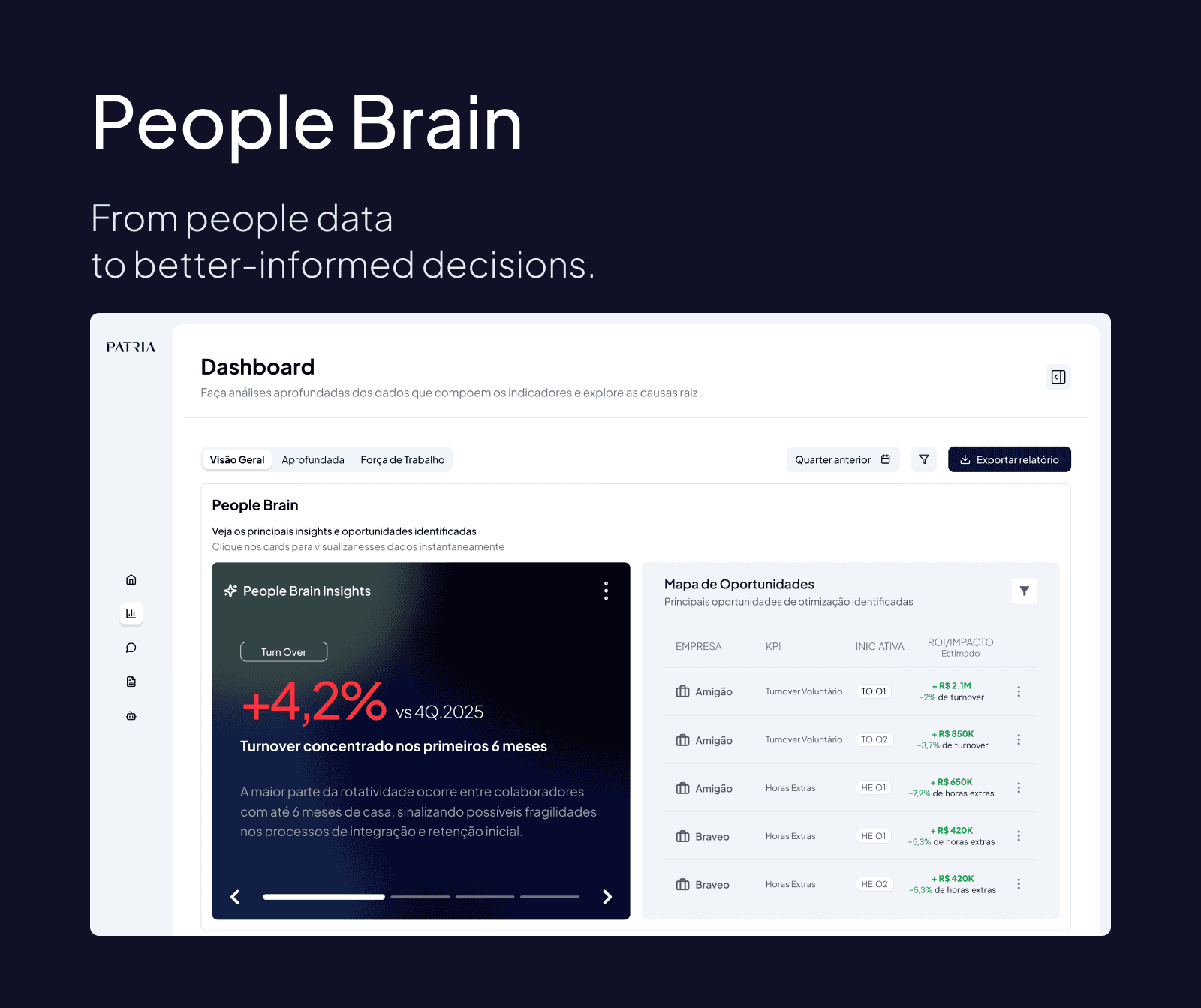
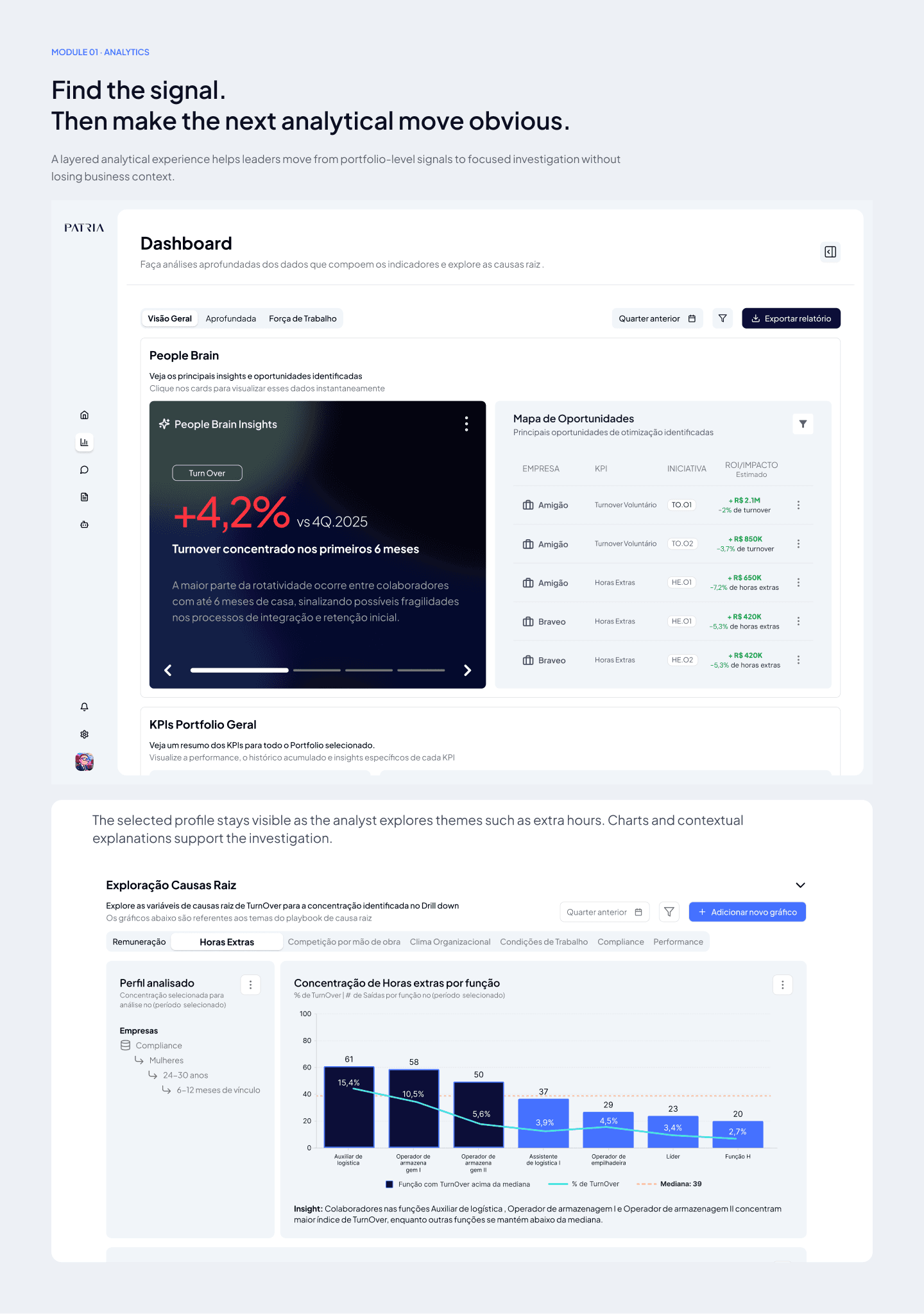
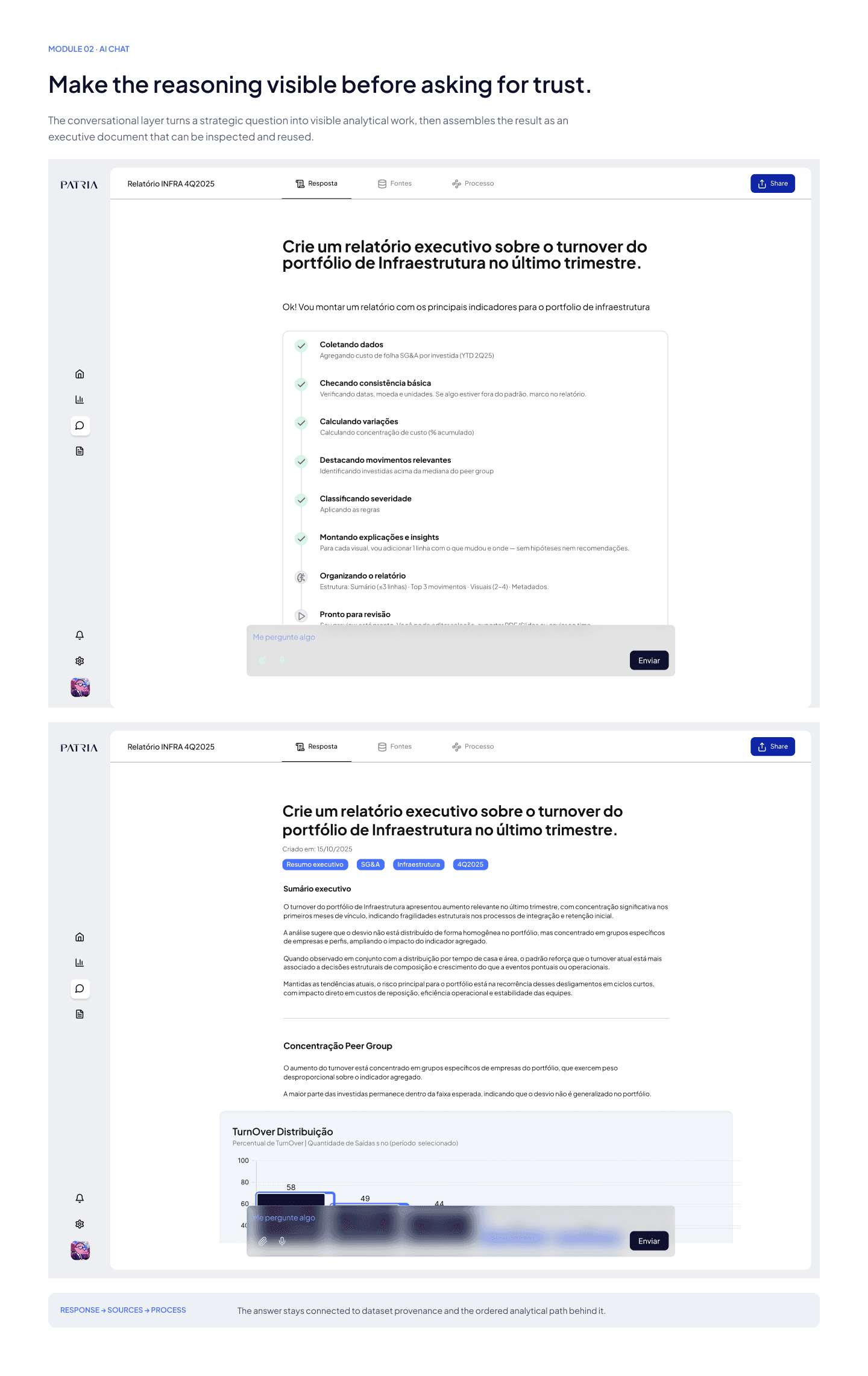

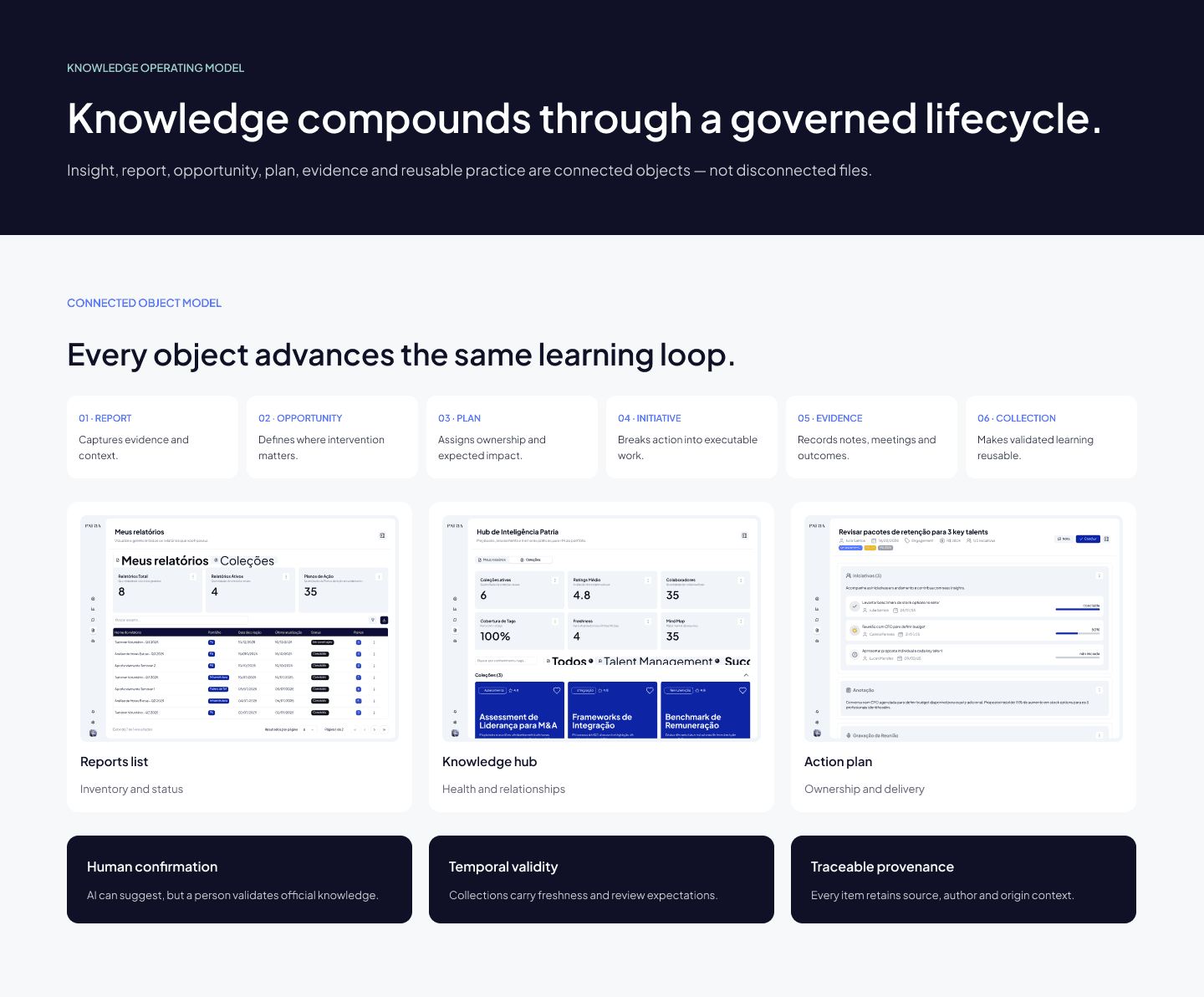
THE PROBLEM The existing reporting process had: a multi-step workflow split between investidas and G&T ~60 days from start to delivery, high cognitive load, frequent rework, and low scalability. The core insight behind the project was simple: It’s not a data problem. It’s a cognitive load problem. SUCCESS CRITERIA We anchored the MVP around measurable outcomes: • Reduce 75% of the end-to-end reporting cycle time • Reduce 90% rework after delivery WHAT WE BUILT 1. A guided thinking workspace, not another dashboard The product was designed to reduce the amount of interpretation users had to do manually. Instead of only showing charts, People Brain highlights relevant variations, compares performance across investidas, and suggests where the user should investigate next. The key product principle was: The system should help users know where to look first. 2. A workflow that follows the real decision cycle We structured the experience around the way analysis actually turns into action: signal → comparison → diagnosis → deep dive → narrative → action plan → learning This helped shift the product from a reporting tool into a continuous decision system. 3. AI as an analytical copilot AI was not treated as a generic chatbot. Its role was to support specific moments of the workflow: Explaining variations and anomalies. Summarizing patterns across KPIs and investidas. Helping users understand likely causes. Turning analysis into executive narratives. Supporting action-plan creation. Preserving reusable knowledge over time. 4. A product architecture built for continuity We defined the MVP architecture around the main product areas: Home, Analytics, AI Chat, Reports, Knowledge Hub, Action Plans, Agents, and Automations. Each area supported a different step of the decision loop, but the value emerged when they worked together as one system. TESTING & ITERATION: We ran multiple rounds of testing with Patria stakeholders, iterating on: • whether the concept matched their mental model (“is this useful / trustworthy?”) • the navigational logic and drill-down paths (“can I get to why quickly?”) • insight card structure (signal clarity, comparability, actionability) • tone of voice (confidence without sounding like a black box) This is where the product shifted from “promising concept” to something decision-makers could actually use.
Hungry for more?